The Workflow Evangelist
Or How to Solve Writing By Removing the Word "Delve"
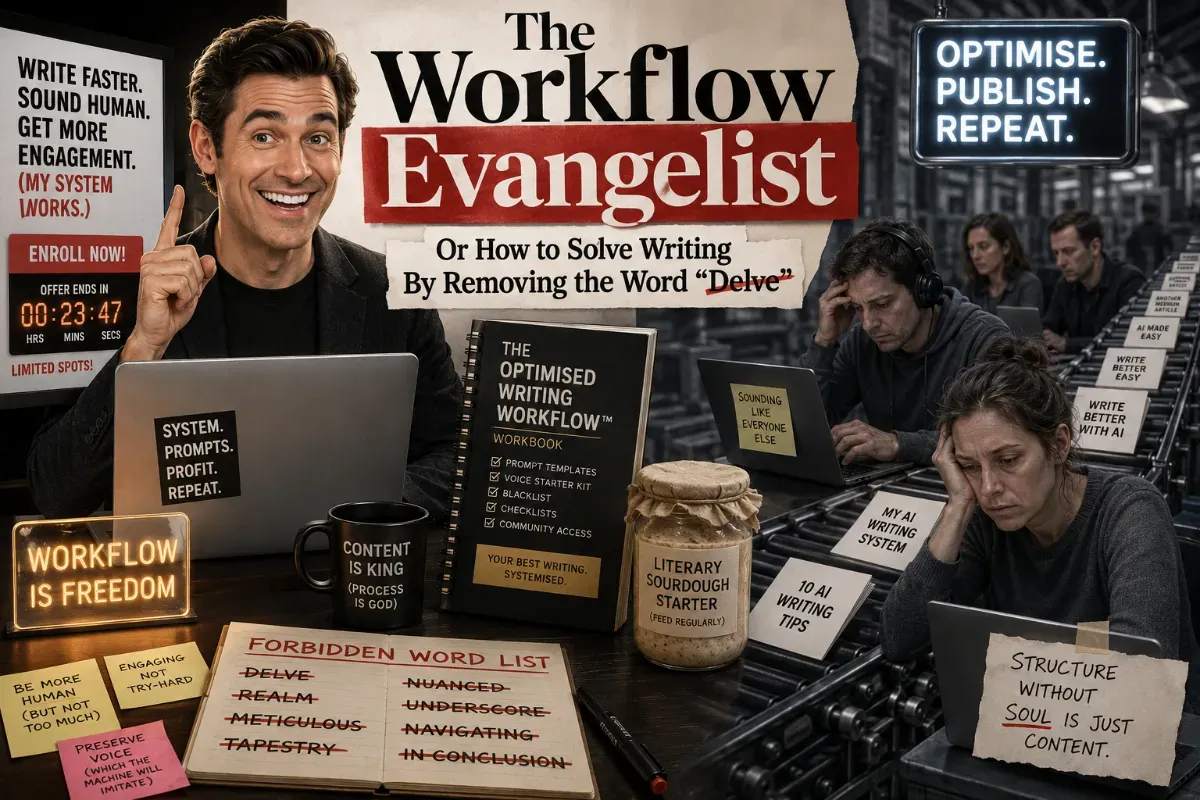
SPECIMEN #020: Promptus optimus
- Classification: Productivity Guru / Workflow Evangelist / Reformed Mediocre Writer
- Habitat: Medium.com, LinkedIn carousel posts, YouTube thumbnails featuring shocked faces and the word "SECRET," course platforms where the checkout page has a countdown timer
- Diet: Engagement metrics, recycled advice, and the persistent belief that process is a substitute for thought
- Threat Level: High to new writers' confidence. Negligible to anyone who has noticed that shortcuts to good writing have a poor archaeological record.
There is a man.
He has discovered a system.
Not just any system.
A workflow.
The article is free to read.
The course, linked in the footer, is $197.
Before his discovery, writing was slow, difficult, and uncertain. People struggled. They doubted themselves. They spent hours trying to say something worth reading.
Now, thanks to his workflow, all of that is over.
He has solved writing.
He was, before this moment, a mediocre writer.
He does not dwell on this.
The Origin Story
It began, as these things often do, with a quiet realisation that nobody else had quite managed to have before.
Most people, he noticed, were using AI incorrectly.
Some were copying and pasting whatever the machine produced and publishing it without amendment.
Others, paralysed by the fear of sounding artificial, refused to use it at all.
Both groups were wrong.
There was, he explains, a third way.
A better way.
A way involving a specific sequence of prompts, a forbidden word list, and a literary sourdough starter, which we will come to shortly.
This way requires reading his article.
It also, ideally, requires purchasing his course.
The course contains the same information as the article, plus a workbook, a prompt template library, and a private community where everyone is optimising their workflow and none of them are writing anything yet.
The Method
The method is elegant in its simplicity.
First, you must have an idea. Not just any idea. A specific idea. Preferably one based on something you have observed, experienced, or thought about.
Then, and only then, you may ask the machine to help you structure it.
The reader may experience, at this point, a faint sense of recognition, as if they have heard this advice before, perhaps from an English teacher, or a book about writing, or the general concept of having something to say before you say it.
This is normal.
Ignore it.
The workflow continues.
The Voice
Next, you must teach the machine to sound like you.
This is achieved by feeding it samples of your previous writing, like a literary sourdough starter.
In time, the machine will learn your rhythms, your tone, your characteristic phrases. It will begin to produce sentences that resemble yours.
Not your thoughts. Those remain your responsibility, and are mentioned here briefly before the method moves on.
But the sentences will look right.
In the modern content economy, that is often considered sufficient.
The Blacklist
At some stage, the practitioner becomes aware of certain words.
Words that betray the presence of the machine.
"Delve." "Realm." "Meticulous." "Tapestry." "Nuanced." "Underscore." "Navigating." "In conclusion."
These must be eliminated.
A list is created. It grows. It becomes a document of forbidden language, consulted before every prompt, maintained with the rigour previously applied to actual editing.
The writing improves.
Not because the ideas are better.
Because the word "tapestry" has been successfully removed.
Progress is declared.
The Prompts
The true power of the system lies in the prompts.
Not ordinary prompts. Optimised prompts.
Prompts that instruct the machine to:
Be more human.
Avoid sounding like AI.
Fix the writing while preserving the voice.
Make it engaging but not try-hard.
These instructions are delivered with great precision, often across several paragraphs, using language that would itself be flagged by the forbidden word list.
The result is a piece of writing that is technically correct, structurally sound, appropriately engaging, and faintly lifeless in the way of a room that has been professionally staged for a property listing.
Everything is in the right place.
Nobody lives there.
The practitioner declares victory.
The Meta-Irony
The article about optimising AI writing was itself written using an optimised AI workflow.
This is detectable.
Not because of the word "delve," which has been successfully removed.
Because of the structure. The numbered steps. The careful absence of any sentence that could not have been generated by a machine asked to write a Medium article about AI writing workflows.
The forbidden word list has done its work.
The voice remains elusive.
The Missing Piece
There is one small complication.
The system assumes the presence of something it cannot provide.
A point of view.
Not a general opinion, or a safe observation that nobody could disagree with. A real one. The kind that comes from having seen something, done something, or thought about something long enough to form a conclusion that might be wrong, and being willing to say it anyway.
This part is not covered by the workflow.
It is mentioned near the end, briefly, in a tone that suggests it is supplementary, like the fresh herbs added to a ready meal.
It is not supplementary.
It is the meal.
The practitioner now produces content at speed. It is clean. It is readable. It is optimised, engaging, and correctly structured. It does not contain the word "tapestry."
It is also indistinguishable from ten thousand other pieces produced using the same method, read by the same people, and forgotten in the same way.
Readers do not object to it.
They simply do not remember it.
The Testimonials
"I implemented the workflow. I fed the machine my previous writing. It learned my voice immediately, which worried me slightly, as I had always assumed my voice was more individual than that. My output has tripled. I am producing more content than ever. None of it is my best work." - Cordelia, 41, Fully Optimised
"I removed every word from the blacklist. My articles became noticeably cleaner. I then noticed that all my articles now sound like each other. I have asked the machine to add variety. It has suggested using the word 'tapestry.' I have declined." - Fenella, 38, Maintaining Standards
"I purchased the course. The workbook contained twelve prompt templates. I have used eleven of them. The twelfth asks me to 'write from my authentic lived experience.' I have left this one for now." - Imogen, 44, Working Through The Modules
"I asked the machine to write like me. It produced three paragraphs in my style. They were competent. I was not sure whether to be pleased or unsettled. I have written this testimonial myself, without assistance, to see if I could still tell the difference. I believe I can." - Gerald, 67, Conducting His Own Evaluation
Field Notes
The workflow is real. The tools are real. The forbidden word list is, in its small way, genuinely useful.
The machine can structure your thoughts. It can tidy your sentences. It can imitate your voice in the same way a parrot can imitate speech, with accuracy and without understanding.
It cannot tell you what you think.
That part remains stubbornly, inconveniently manual.
No workflow changes this.
The course does not mention it prominently.
Advisory
If you encounter Promptus optimus in the wild, do not be alarmed.
Nod politely. Acknowledge the workflow. Accept the prompt template if offered.
Then go and write something the machine could not possibly have invented, because you are the only person who has seen what you have seen, thought what you have thought, and arrived at wherever you currently are by exactly the route you took.
No prompt optimises that.
The word "tapestry" was removed from this specimen during editing.
You are welcome.
A note on the specimens: Promptus optimus is an operator. He sells the course, sets the countdown timer, and knows exactly what the workbook is worth. Cordelia, Fenella, Imogen and Gerald are not operators. They are the drawn-in, and they deserve your sympathy rather than your scorn, because what they have lost is not money. It is their own voices, surrendered voluntarily, one optimised prompt at a time.